

Cardinal Colors
A seasonal suggestion

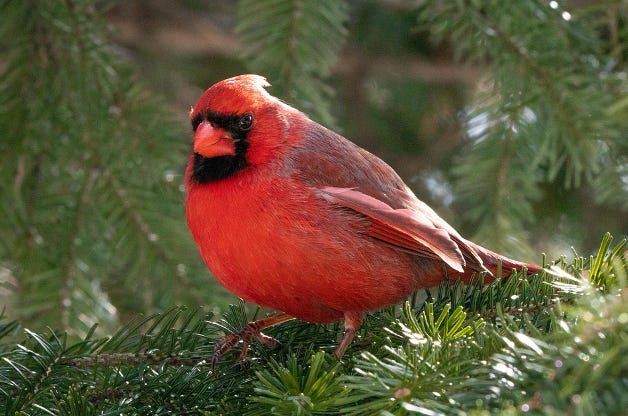
“Oh, look! It’s a cardinal!”
“Male or female?”
“What?”
“Is it bright red?”
“Well... yes. Of course.”
“Male. Boring.”
And they are. Oh, they’re pretty, sure, especially in the winter, when everything around them is covered in white snow, and they stand out like a promise that there is life in the cold world. But I say “boring” because of how all their beauty is on the surface. It’s showy. It’s in your face. It’s “Look at me! Are you looking at me? Look! Look!”
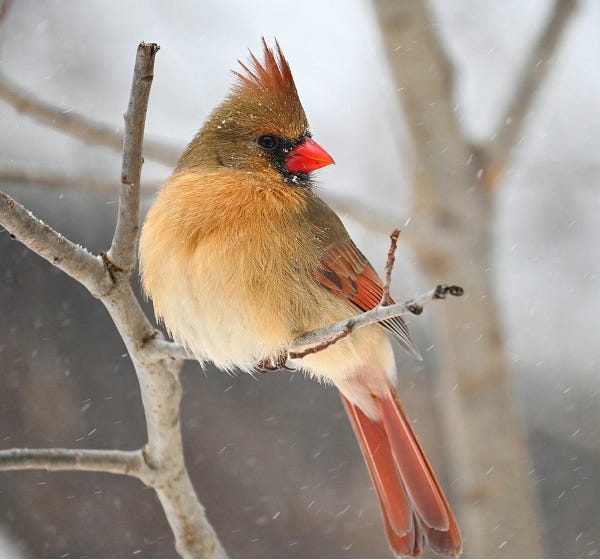
In my not-so-humble opinion, the female is far more beautiful than the male. Her soft buff body, which seems to glow from beneath the feathers, is accented by the bright orange beak, the black eye patches, and the peachy red crest and tail feathers. Then there’s what happens when she takes flight: the wings spread, and for just fraction of a second, a bright orange patch is visible beneath her wings. Blink, and you’ll miss it. Unlike with the brassy male, to appreciate the beauty of the female, you must pay attention.
Here in New England, where we have cold, snowy winters, I like to keep bird feeders on my deck, filled with black stripe sunflower seeds. Lots of birds visit them: chickadees (my favorite), titmice, gold finches, house finches, various sparrow varieties, juncos, nuthatches... the list goes on. Oh, and cardinals, who tend to appear together in mated pairs.
The male cardinals are fairly aggressive, taking no guff from any bird that might want to chase them off the feeders. The only birds the male cardinals give way for are the larger members of the woodpecker family, as though the cardinals know they’re no match for the long, pointy beak of the woodpecker with the power of its larger body behind it. Who could blame the pretty red boys for refusing to give way to, say, a sparrow, or for avoiding the rose-bellied woodpecker?
The female cardinal challenges no one else on the feeders. Instead, she will more often be seen on the deck floor, picking through the detritus of empty hulls in search of a whole seed dropped by a careless nuthatch or finch. And this bothers me. Because when she does find her way to one of the feeders’ perches, she stays only until her mate flies up at her and forces her back to the deck floor’s leftovers. It’s true I once saw a male offer a seed to a female. It was mating season. That is, he wanted something in return for taking her out to dinner.
It’s not only the bright red flagrancy of the male cardinal that reminds me of the red-garbed men who’ve been given the rank of cardinal in the Catholic church.
Searching for images of groups of Catholic cardinals, I found no shortage of photographs. Pope-selection conclave meetings, groups of cardinals holding matching white umbrellas against a light rain, and shots captured from the 2024 film Conclave were easy to find. And while the cardinals are the most flagrant of the ordained, even everyday priests, when celebrating mass, might dress in various colors, depending on the liturgical season: green (Epiphany, or “ordinary time”); purple (Lent); red (Holy Week); white and gold (Easter); red again (Pentecost); green again (more ordinary time); blue and then rose (Advent); and white/gold again (Christmas). These vestments are typically lush with gold embroidery.
Not so with groups of nuns. Not only did I find precious few photographs of nuns in groups, but also the search results often included types of images that I never saw in my cardinal searching—some ridiculous, and some even salacious. Almost all the nuns, of course, were dressed in black and white, with the occasional tunic of Virgin Mary blue.
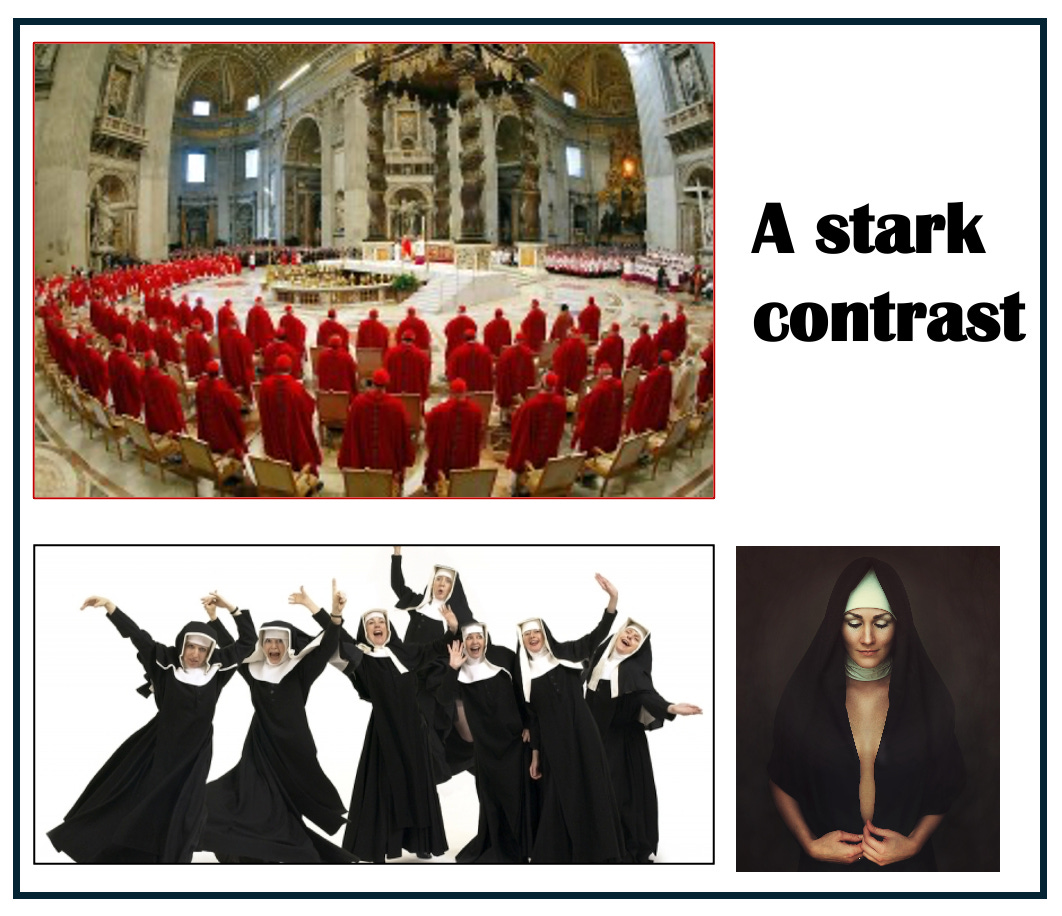
Neither priests nor nuns are allowed to marry or enjoy any of the physical intimacies that relationship implies. But there the similarities diverge. He is allowed power, authority, and outward beauty. She is denied all of that and must, analogously to the birds, humbly endure leftovers.
As we approach the season when so many holidays are celebrated, take a moment to consider why the Abrahamic traditions (Judaism, Christianity, Islam) call to a Father but not to a Mother. Maybe, if we look hard enough, if we pay close attention, we’ll see the beauty beneath the show, the toil beneath the glory, the beneficence beneath the bravado.
So, look. Look again.
[Nota bene: This post was inspired by the work of artist Jean. S. Kaiyou, who posted a drawing of a female cardinal on her December 5, 2025 Substack.]

You can subscribe for free to Robin Reardon Writes, though I hope you’ll consider becoming a paid subscriber. It’s not expensive, really! You’ll have access to everything I write on Substack. You’ll also have my undying gratitude.

One more thing: If you share this post, you’ll get credit for generosity, and I might get more subscribers.
I’m an inveterate observer of human nature, writing stories about understanding and connecting with each other. My primary goal is furthering acceptance of people who appear to be different from “us,” whoever that “us” might be. Check out my books on my website.

Ever the observer of all nature, not just the human kind, you have once again “Hit the nail on the head!” as my father used to say. Informative and insightful. Thanks.
That observation about the female's orange underwing flash is spot on. I've noticed that at my own feeders and it's such a subtle reward for paying atention. The parallel between feeder dynamics and institutional power structures is clever, tbh it's kinda wild how these patterns repeat across contexts.